
“Full fathom five thy father lies;
Of his bones are coral made…”
— William Shakespeare, The Tempest

On the night he catches the merrow in the fishing net, Jack is not meant to be on the Dagný. It isn’t his fault, strictly speaking—Cliff Walders had bunked off, on account of it being the winter holiday, and Dexter had needed a deckhand, and Jack had needed the fifty quid, and Mr. McMorrow, who ran the fishery, hadn’t had anybody else to give it to, and so in due course the situation had resolved itself. It was all done under-the-table-like, just a favor between friends—Jack and Dexter go near twelve years back, to primary school—and Mr. McMorrow hadn’t minded, in fact he does it often. Jack had slipped out of the house just after 3 AM and made the misty hike down to the harbor without giving it a second thought. He’d expected a net full of whiting and a hot breakfast after. He hadn’t expected this.
The Dagný isn’t a large vessel by any means: just an old trawler, which Mr. McMorrow had outfitted with a net himself. Jack is all alone at the stern, freezing even in his jacket, his feet spread wide from when the deck had been set askew by the merrow’s weight. His first instinct is to shout for Dexter but Dexter’s at the helm listening to his Walkman—singing along to Dionne Warwick, and badly at that—so Jack swaps it for his second instinct, which is to squint down at the merrow in the still-raised net and say, gruffly, “All right.”
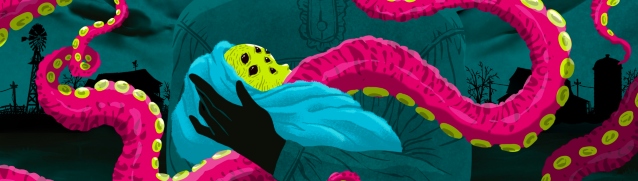
It isn’t as if he’s seen a merrow before, or would even have counted on them being real, but between the long kelp-green hair and the glinting tail where a pair of legs should go he’s not sure what else it could claim to be. It had almost certainly been caught in the net by accident. It looks a bit startled, tangled up with the wiggling whiting like they’d all been at a party together. In the glare of the sternlight Jack can make out the details of its strange, pale body clearly: the wrasse-like red-tipped ventral fin, the near-translucent skin over its stomach, the oily black guts inside. No navel, no nipples. The colors of its scales shift like petrol in a puddle. It adjusts itself clumsily, tail flapping, and tries to pull itself up by the netting with its clawed, webbed hands. It’s a wretched, gorgeous thing.
Jack gives it—well, them; oughtn’t go on calling them an it—a wary nod. Might as well strike up a conversation, he thinks.
“You speak English then?” he calls. His breath spills from his mouth in a cloud.
The merrow cranes their neck, gazing back out at the sea behind them with golden, wide-spaced eyes. Rows of lacy dark gills flutter under their jaw. A sharp breeze pulls their scent to Jack, overpowering the familiar mix of fog and fuel: the clean salt scent of high tide.
“Fie,” they mutter as if he isn’t there at all. “What a fool I am. Let loose the net, little sailor, I must get back.”
Jack braces his gloved right hand on the pulley. “Back where? The sea?”
The merrow levels him with a gaze that fillets him in one quick stroke, picking out the bones of him. He shudders; not from the December cold, but from something more primal, a sort of prey response.
“Back,” they say, “to my cages.”
Jack laughs in disbelief. “Right, mate, you want a cage, just come ashore. Town’s shit enough and thrice as big.”
The merrow tilts their head. They lean forward, best as one can lean forward in a fishing net—the motion dislodges several whiting, dropping them back into the water—and in spite of himself Jack recoils. Their body has got to be seven feet long.
They close their bony fingers around the ropes, sizing him up with a thoughtful, burbling hum.
“You’ve a soul I know, young master,” they say with a lipless smile. “Shen eh, I see the waves of grief and goodness there, and a great thunder over them besides. I have seen it before, I have, ‘twas many tides past. I beseech the young master, grant me myghin, as humans do. Mercy.”
“Mercy, eh?” Jack struggles to understand what they’re saying. Their light, rippling accent isn’t quite like any he’s ever heard. “I dunno…I mean, if I drop the net I’ll lose the fish…”
“These little ones,” the merrow says, stroking the bellies of the whiting with one hand, “would return to your noble net, if I so asked them.”
“Well, there’s not much sport in that, is there?”
“Jack!” That’s Dexter, thumping along the deck, growing closer. “Pull anything in, there?”
Jack looks back at the merrow, his heart twisting left and right with indecision. He won’t get his pay if he doesn’t meet the quota, that’s for certain—no catch, no pay, old McMorrow is so fond of saying—and he’d had plans for it, a couple weeks’ groceries and a pair of new boots, for the ones he’s got have been worn through. But this is a living thing—a mythic thing—a thing that should not be real, and yet is—and it’s facing him across the waxing dawn, waiting for his answer. And Dexter would forgive him. He always does.
His fingers slacken around the pulley.
“Yes, yes,” the merrow says, almost admiring, “I am certain of it now. Your soul is like the Thomas-soul.”
And Jack goes absolutely still, for he’s got no idea how this creature knows the name of his dead father.
He says, “What?”
“I would seek you faithfully,” says the merrow, “for all your years after, sailor-man, until my debt were repaid…”
“Jack?” calls Dexter, about to round the corner.
Jack swears, and tips his head back to the sky, and swears again—and lets the net drop back into the churning black water.
Jack had learned three things from his father: how to gut a fish, how to hate himself, and how to keep his God-given soul from a merrow. The trick, boy, is to make a game of it. The old bastard had made games of most things. It’s been nearly a year since they put him in the ground and Jack can’t help but wonder, sometimes, if the cancer had been a game, too.
He can still picture him in the kitchen doorway, one thick arm propped up against the frame, a glass of whisky catching the lamplight from the hall—he can still remember the words, although the pauses and inflections of the voice saying them have eroded. Fond of trades and trickery, they are, and covetous besides…should you chance to meet one, Jack, and he invites you to his home beneath the sea—remember where you come from. Don’t follow him down. Truthfully, those middle days of Jack’s childhood had not involved much talking from his father at all: just an empty seat at supper, and a body breathing on the couch at noon, and the sound of quiet crying from the bathroom long after bedtime. Jack, foolish and small, had cherished simply being someone that the old man said things to, and so it had taken him far too long to see those sparsely given words for the smoke and empty air that they were. He had not thought to ask, then, the question that would come to haunt him in the world defined entirely by his father’s absence—the question that bucked hopelessly in the chest as he watched the merrow’s body slip beneath the night-touched waves—But what if I want to follow him, Da? What if I want to?
After he and Dexter dock the Dagný, and old McMorrow’s had his fill of shouting at them for not managing to catch a single ruddy whiting in the middle of ruddy December, Jack walks back into town alone, and the old memory of his father in the doorway follows him. It follows him past the old abandoned shipyard, and it follows him past the queue outside the Jobcentre, and it follows him down James Street, all the way to his front door. His mother greets him in the entry when he comes in, her greying hair hastily done up in a clip, the blazer of her old mauve suit off by one button—heading to another job interview, likely. Jack’s stopped keeping track of them.
“How did it go?” she asks, fumbling with her right earring. “Paid you in cash, I hope?”
“Didn’t pay me at all,” Jack answers, already halfway up the stairs. “Caught nothing. Bad luck, is all. I’ll work something out.”
He shuts the door to his and his younger brother Gareth’s shared bedroom before she can reply. He hasn’t got the stomach for the usual reminder that with Dad gone and Mum being sacked and Gareth off to university come September it’s up to him to keep things afloat. Every pence counts, and so on. Dexter’s been kind enough to put in a good word for him with old McMorrow, let him pick up a shift on the Dagný here and there when income’s lean, but after tonight’s performance Jack doubts that old McMorrow will be receptive to that good word again.
He ought to be more troubled by it, but that’s not the sort of person he is: a problem’s not a problem until it’s got you by the leg. Instead his mind keeps veering back to the merrow, and the way their uncanny face had glistened in the dark; and the luster of his father’s name in their voice, like a coin being held up to the light.
Gareth is still out at his friend’s for the weekend: his single bed, pushed up against the room’s blue left wall, is neatly made, and his jacket is missing from the hook on the closet door. Jack kicks aside a pair of jeans on the carpet, stands over his own bed for a moment, and then tips forward, facedown. The dull prickle of exhaustion behind his eyelids does nothing to carry him to sleep. He keeps his nose pressed to the mattress until he can’t breathe anymore, then turns his head on its side, staring dimly at the wall. The pipes are rattling inside, already waking.
Don’t you follow him down, his father’s voice reminds him, the consonants bleeding into one another.
Jack thinks that if it meant getting out of here—out of this room, out of this house; out of this sad, staggering town—he would follow that creature anywhere it led him.
“I have never heard such a lie,” shouts Trishna, loud enough for the whole pub to be party to her opinion. “And I have heard a lot of lies, Jack, and no small number of them from you. Dex, Dexter, my beloved Dexter Aguewgbo Jackson, of the Keith Street Agwuegbo Jacksons, tell me you don’t believe this, because if you believe this I will be forced to end the friendship in shame.”
“Well,” Dexter says, helplessly.
Jack has been friends with Trishna and Dexter since primary school and he has built up a certain weary tolerance for this kind of treatment. They’d met when Trishna and Dexter were eleven and Jack was twelve, having wound up in the same year since Jack had been held back on account of his dyslexia. Trishna Poole, known in those years as the terror of the St. Ninian’s trombone section, had gotten into a fistfight with Jack over some trading cards, and saintly Dexter had tried to convince them to stop and gotten caught in the crossfire, and all three of them had been upbraided for it and had to mop the gymnasium floors each night for a week. It’s been near thirteen years since then, and Jack and Trishna had gone out for three of those along the way, but Jack knows Trishna would still get into a fistfight with him over the right topic.
On the night that Jack’s dad died—five years past, now—Trishna and Dexter had both come over to the Kersey house and spent the night, laid out in sleeping bags on the bedroom floor. They’d talked to him until dawn about everything that they could think of, as if afraid that a moment’s silence would swallow him whole. Their voices had been hushed, so as not to wake Gareth in the bed beside them. Jack remembers wondering, over and over again, how it was that Gareth could sleep at all. Since then they have not really asked him to talk about it, and Jack does not know how to talk about it without being asked, and so they do not talk about it.
The three of them are clustered around their usual standing table in the corner, Jack with his cranberry juice and Trishna with her lager and Dexter also with his cranberry juice. It’s good to see Trishna even though at this present time she is being horrible. Jack has had to content himself with intermittent phone calls since her move in March. She had gotten a mohawk in London, and she keeps playing with it between sentences, or sometimes in the middle of a sentence, preening in the lamplight like some overgrown punk peacock.
“Only,” Dexter tries, ever loyal, “only he’s not had a predilection for fanciful notions, historically.”
“Right, would’ve been more likely to just blame it on the net and move on.”
“You’re not listening,” Jack interrupts, jabbing the surface of the table with his finger for emphasis. “They kept going on about cages. Said they had to get back to them. What d’you suppose it means?”
Trishna twists a lock of her black fringe between her fingers, dark eyes crossing under the shape. “You ever considered that might be their business? And not fit for human contemplation?”
“I’ve never known Jack to contemplate owt.”
“All right,” Jack snaps. “Fuck the both of you then. I saw it.”
“Why fuck me?” Dexter cries, throwing up his arms. “I believe you, moron!”
“And what else is new,” says Trishna. “You’d believe the worst nonsense in the world provided it was him saying it.” She drains the last of her beer, slamming down the glass when she’s through. “What I really can’t believe is that I came home for this. Merrow! You should go back to ringing up old ladies at the corner shop, Jack, you’d not get sea-madness from that.”
Jack scowls down at his own glass, tilting it to one side. The corner shop had been his sixth job in three months, and had come and gone as quick as the rest. It’s this damned recession, Jack, you can’t outrun it, Mrs. Lowther had said with a shake of her head. Nowt I can do I’m afraid. Christ, what had he even bought the cranberry juice for?
A weight settles on his shoulder, pulling him back, and when he glances over his nose he sees Dexter’s hand there on his sweater.
“I really do believe you,” Dexter says earnestly—sweet, reliable Dexter, with his afro and his glasses and his bright familiar eyes—Jack’s best friend in the whole world. “I think. Sort of. No harm in it, anyway.”
“Thanks man,” Jack says, and continues to look at Dexter’s hand, like an idiot.
“Maybe the cages are…something it keeps,” Dexter suggests, pulling away as Trishna gets up to pay off the tab. “Or cares for. I don’t know. I guess everything has a home to go back to, if you think about it.”
The cranberry juice is sweet on Jack’s tongue. He tries to unstick the truth from the taste: Not me, mate. Between the cage and here, what’s the difference?
They all walk back through the rain-slicked night together, hands in the pockets of their jackets. The Christmas lights hung from doorways illuminate their figures in red and green and gold, Jack and Trishna sharing a cigarette and Dexter counting the years that it’s stealing from them, like he always does.
“I prefer the people I love alive, thank you,” he says when Trishna teases him for it. His voice is low and gentle under the windowsills, his breath mingling with the smoke until it disappears. Jack wants to turn and ask him if that’s what love really is, if it’s just a matter of looking at someone and not wanting them to die, but maybe he already knows the answer.
Gareth had been the one to do the speaking at the funeral, his brown hair softly combed, his black trousers too short for his lanky legs. Jack can’t remember what it was that he had said. There had been a bloke from the shipyard, too, in a crumpled suit, who had read Psalm 107; Jack thinks his name was Fletcher. When the liturgy was done he’d turned his eyes to the clerestory and said, I’ll be seeing you, old friend. We will meet again. And Jack had wanted to stand up and ask him how he could be so sure, and what the hell they were all here for anyway; and it must have shown on his face, because in an instant Gareth’s hand had closed around his, anchoring him to the pews, and the stone, and the ageless dirt beneath. Jack had pulled his hand away, closed his other over it—to shield it from the needing.
Jack’s mum does not get the job. She announces this on Monday, at breakfast. Jack and Gareth are seated side-by-side at the kitchen table, eating their eggs in the thin morning light—Gareth had come back from his friend’s place the night before—and Jack is hunched over his plate, trying not to look at her. She doesn’t wallow over it, telling Jack to go into town and ask Mr. Platt about seasonal work at the post office.
Jack stabs an egg yolk with his fork and pushes the reality away, as far as it will go. The merrow will not leave his mind. He’d dreamed of them, the night before, the odd syllables of their voice pouring into him like wine.
Maybe he’s still dreaming.
He tucks his mother’s advice and the good that it won’t do into his pocket, and instead of going to see Mr. Platt he drives out to the beach just north of town, where on rotten days he likes to walk from one end to the other and back again. It clears his head like a stiff breeze through a cobwebbed room, and is damn near the only place along the water that isn’t littered with the rusted-out hulls of old ships. There aren’t many people around during the week, just the occasional fisherman or cockle forager. When Jack parks the old Cortina there just after eleven the only company he has on the dunes are the terns and eider ducks. The wind-scraped sky overhead is the color of milk glass.
He’s halfway down the shoreline, bare feet thick with wet sand, when he sees the merrow again.
“It’s you,” he says, stunned. Had his hope had a scent, somehow, that it had followed?
The merrow drapes themself across the boulder beside which they’d surfaced, propping their torso up by the elbows. They look cheery, or as cheery as any merrow can look; there’s a bluish flush to their cheeks, and they are smiling up at Jack with all their short serrated teeth.
“Tis I,” they say. “Before we go on, an exchanging of names, if it pleases you. In the tongue I love best I am called Cóemchuachma. What do they call you?”
Jack calculates the risk of being honest. He doesn’t suppose the merrow could do much with only his name.
“Jack. Just Jack.”
“Tis a fine name, that. A gift from your lord father?”
Jack frowns. “Wouldn’t call it a gift. It was my great-granddad’s name, that’s all. The sort of thing that gets passed around. Gareth’s the one who got a fresh one.”
Cóemchuachma picks at a dead barnacle on the rock. In the plain light of day their body is the color of river silt, tinged with sea-glass-green. Jack’s eyes trace the subtle assertions of bone beneath the skin; countless narrow ribs, and a rickety spine.
“You…know my father, then?” he ventures.
Cóemchuachma laughs to themself, sharp and fleeting as a whitecap.
“I know countless fathers. Sons and mothers, kings and pirates. It’s many a friend has old Cóemchuachma.”
“You said his name when we met,” Jack reminds them, fingers curling in his jacket pockets. “You said my soul is like the Thomas-soul.”
“And that it is. Aalin, aalin. All stitched with longing, just the same—as the loveliest of souls surely are. I would know it anywhere.”
“Don’t be lying to me now,” Jack warns them, though his heart trembles inside of him. “I won’t take kindly to it. Why have you come back? You’re trying to lure me down below, make a meal of me, is that it?”
The waves rush past Cóemchuachma, foam swirling around their glassy torso. Jack can read no human expression on their face.
“I have come up the waves to see you, Jack, Just-Jack,” they tell him after a time. “Your deed has been much present in my mind. Let it never be said that clever Cóemchuachma forgets. I smelled your soul from fathoms-deep, the spice of longing fresh upon the wind! I wondered, from whence does such a sweet scent spring? Surely a creature friendless, orphaned, which has known hunger, which has known grief, each feeling fresh and flavorful as blood. But lo, it drew me here to you.” They tip their head back, as if luxuriating in a fragrance, but all that Jack can smell is low tide and old steel. “A reminder, Just-Jack, that I owe what I owe. For your myghyn, for your kindness, I would offer you a kindness in return. What would you ask of me? You need only name it, soothly, and I shall make it real.”
They say it with the same confidence Jack’s heard men speak of welding steel until a great ship comes of it, like it’s only a matter of patience and resolve. He shifts his weight to his other foot, considering the offer.
He reckons if the merrow tried to drown him, he could fight them off.
Probably.
“I’ve no need of anything,” he says. “But I want—”
What he wants overwhelms him. A reason, a cheque, a kind word, an answer. A tomorrow worth waking up for. All of it opens inside of his chest, all at once, begging to be fulfilled—knowing that it never will be.
I want you to drag me down to the deepest part of the world, he thinks, and leave me there.
“I want to know how you’ve come to speak my father’s name,” he says, hauling up the courage from an unknown place. “And I want to see those cages of yours.”
Cóemchuachma cocks their head and settles their chin on the heel of their palm, the sunlight glinting off their scales, their fins folding and unfolding.
“It has been a spell since I brought a man below,” they say, thoughtfully. “Yes, a good long while—and why is that, when they make such pleasant company? Kiart dy liooar! ‘Twould please me to the very bones. Shall we go now?”
Jack falters, looking over his shoulder, though he isn’t sure what he’s looking for. It isn’t as if the town will be looming behind him, begging him to stay.
It isn’t as if anyone on earth would ever beg him to stay.
He turns back to Cóemchuachma.
“Sure,” he says. “I’ve got nowhere to be.”
It’s about the givin and the takin, boy. The winch of a fishing pole had always looked right in Jack’s father’s calloused hands, same as a mallet, same as a glass. There had been a handful of occasions—waking days, as his father would call them—when he and Jack would clamber into the old Cortina before the break of dawn, nothing but a tackle box and a pair of cheese and onion sandwiches to their name, and drive an hour north in search of sea bass. When the radio played Badfinger they would bray along, seeing who could go the loudest. He’d had a voice like thunder, Jack’s father. It had rumbled over the tide in the coming morning, nearly lost to the wind: When you’re wantin a fish you can’t pull him in all at once. Let him go, then bring him back, and let him go again, just enough for him to think he’s free. All of life is like that, you’ll soon learn—just you mind that you’re the hook, and not the fish. He’d said, All right, we’d best be gettin home then, but he’d been looking out at the sea.
Cóemchuachma gives Jack a long strip of salmonskin leather to wear as a belt, assuring him that it will absolve him of the need to breathe beneath the water. Jack, stripped down to his boxers and T-shirt, ties it around his waist, his bare skin flinching at its touch. The waves are biting when he wades into them, but his bones acquaint themselves with the cold soon enough.
“You sure you’re not intendin to drown me, mate?” he asks the merrow, who slips their head halfway beneath the surface and giggles, bubbles fluttering around the sound, and doesn’t answer one way or the other.
He follows them farther and farther from the shoal, until the slope dips lower than his toes can touch. Treading water, he watches Cóemchuachma give him a beckoning look, watches their finned back breach the surface as they depart. He lists the names of all the saints he can remember, and gulps down the biggest breath his lungs can hold, and dives.
It’s a long dream of a swim, just bubbles and blue water, schools of darting fish passing by in shimmers. Jack tries not to lose sight of the merrow’s tail. Whatever magic the sash from Cóemchuachma possesses, it keeps his eyes clear and his body warm, and he hardly has to breathe at all. The relentless kicking hardly tires him. In due time they clear the murk, fathoms deeper than Jack had thought to track, and Jack finds himself floating over the sunken ruins of an old iron ship—a destroyer, by the look of it.
The decaying hull is grown over with algae, and where once the decks had been bare there are now ambling reefs and kelp beds, dotted with anemones. Skates and rays glide along the seabed, darting between the rusted scuppers and the black branches of magnum sea cucumbers. A compass jellyfish is billowing where the light eats through the distant surface, and a few meters off Jack can make out a shiver of basking sharks roving sociably over the bridge. It might as well be the ruins of a lost civilization, made into a habitat by time.
The only thing the place is missing, far as Jack can tell, is other merrows.
“Có, you live here all alone?” he calls out. His voice is muffled by the water, near-incomprehensible to him—but Cóemchuachma seems to understand. The merrow weaves through the swaying kelp fronds, savage and lovely in the water in a way Jack could not have prepared for, and laughs.
“Not alone,” they say, fingertips skirting the head of a stray cuttlefish. “They have many songs to sing, Just-Jack, and tales to tell. In the summertime I do wend my way to the isles, where my fellow mooir-folk call down the storms. ‘Tis not so lonely, not at all. Come this way.”
Jack follows them by breast-stroke along the quarter deck and then below, kicking through an open hatch. The walls of the passageway are coated in barnacles and rust. Jack’s visibility is barely two meters. He focuses on Cóemchuachma’s caudal fin, faintly gleaming in the dark. The merrow leads him deeper in, through the messroom and the galley, until they emerge into the washroom.
Jack cranes his neck, treading water. There’s a wide hole in the port-side wall, edged in rust like a cauterized wound. Light spills in through it, illuminating the walls and floor.
Among the crushed sinks and cracked mirrors, Cóemchuachma has made crude shelves of a sort from dead corals. Laid out on the shelves are assorted trinkets: a queen conch and a broken urn, a green wine bottle still corked, the barnacle-crusted head of a pilum. In the deepest corner, where the light can’t reach, a sight catches Jack’s eye: an array of perhaps a dozen old lobster pots along the floor.
“Ah, my cages,” sighs Cóemchuachma from over his shoulder. “Glimpse the souls inside them, Jack. They are made of foddiaght, you see? Do you know it?”
Jack swims closer, and Cóemchuachma follows at his side. Upon closer inspection, the pots are not empty. Each one of them contains a lobster.
“‘Twas a Manxman who told me of it, long ago,” says Cóemchuachma. “I think another word for it is longing, but this longing is for a place that never was, a place that cannot be. That is what I have made of it. When a soul is tangled up with foddiaght I can taste it on the wind. At the hour of the soul-leaving I sing for them a song of the gone-places, and sure enough they come to me, and I capture them for keeping.” They swim closer, peering at the creatures inside: some small, some large; some blue and some brown. “‘Tis no sight in this world more winsome well than a soul stitched with longing.”
As Jack gazes at the lobsters in the cages, unease begins to creep down him in inches, skull to stern. He feels sick, his blood thumping thinly in his ears. He can’t tear his eyes from the lobster in the foremost pot, a sturdy brown-green thing whose antennae are slowly prodding at the mesh.
“These—” He falters, the bubbles from his silent voice rising swiftly out of reach. “Were people, then?”
“Does it trouble you? It oughtn’t. They’ve no need for them, not any longer.”
The dread churns into anger. “It’s not some bauble, Có, it’s a person’s soul. You can’t just cage it up and gawp at it. It’s a precious thing, it’s meant to…”
He trails off, not knowing the words. It’s not as if he believes in souls in the Christian sense. What is a soul but all the things a person felt, tangled up in some invisible knot of being—what soul persists without someone to remember it?
“It’s not yours,” he settles for saying. “It’s not anybody’s.”
Cóemchuachma slips closer, obstructing Jack’s view. Their once-sodden hair now billows silkenly around their face like the tendrils of a jellyfish.
Jack wishes that they would blink, if only just once.
“Shall we play a gamman schlei?” they ask him. “A game?”
“No, thank you. Don’t think so.”
“Just a small one. If’n you can point me to the Thomas-soul among these, then you may keep it for your own.”
Jack can’t help it—he laughs. As if he’d be so stupid! “And what if I can’t?”
“Then I will drown you,” Cóemchuachma answers merrily. “And keep you for my own.”
Warily, Jack examines the creatures: the little blue lobster four cages away, the huge and sleek black lobster near the back. Without thinking—drawn gently to it before he can identify the pull—he lays his hand on the brown lobster’s pot, and its antennae tickle the pads of his fingers, almost a question. Cóemchuachma eyes the interaction curiously, looking from Jack to the lobster and back again. Their long mouth splits into a smile.
“It is well that you guessed rightly, Jack,” they say. “His soul calls to yours, does it not? Do the edges meet?”
Cold comprehension seeps through Jack from the skull down. He stares dumbly at the lobster, its stocky body and powerful claws, the tiny nicks in its carapace—its beady black eyes, peering into him, reminding him of—
Of…
“You see here, the wee blue one was a ship’s captain, a tamer of the seas in days long by. And my lovely white treasure, ah, yes, with her perfect eyes—aalin erskyn focklyn—she was a fisherman’s girl…”
Jack reels back, flailing blindly, his back landing hard against the wall.
“And you,” whispers Cóemchuachma, “your soul is so like his. From the moment I beheld you I could see it as in a mirror. I reckon I must let you take it but oh, it is so hard, the letting. So be it—you may keep the soul, your aundyr, sand-toucher, as Cóemchuachma promised—but keep it here, with me…”
“I,” Jack says faintly, small and trembling at the bottom of the world, remembering so many things, the empty glass the doorway the singing the shouting the giving the taking, “I have to go.”
“Oh, stay, stay, I pray you,” Cóemchuachma calls. They cup his cheek in one lovely palm, cool and entreating, their clawed thumb gently grazing the corner of his mouth. “You would look so pretty here among them, my Jack.”
There is a moment—a lone cresting wave of a moment—when Jack almost does. He breathes out shakily, eyelids growing heavy with wanting. He could let Cóemchuachma pull him under, and remake him as they pleased, and he would never suffer a moment for it. There’s nothing for him landwards, is there? Had there ever been? What good had he ever done to anybody? He’s not like Gareth. Not like Mum. Not like Trishna, or Dexter—
I guess everything has a home to go back to if you think about it.
His sense juts back into him. He slaps Cóemchuachma’s hand away, his whole soul stung like a wound with salt.
“No,” he mumbles, “no,” and kicks clumsily away, and out of the port-side hole, and out of the wreck. Out of the sea. Anywhere.
The merrow does not come after him. It only floats there in the corpse of the old ship and watches him go, with a look in its eye like the rage of the ocean itself. Jack looks back once and not a second time. By the grace of the salmonskin belt—or maybe just by the grace of the saints—he makes it to the surface. When he crawls up the shore, shaking, half-drowned, the air burns in his lungs like acetylene. The night is dark as coal.
One night Jack had come downstairs to get a glass of water and had heard his father calling his name, in a small, half-dreaming voice. It had not been right, Jack thought, for his father to have a voice so small. Although he’d longed to run he had gone in and held his big, cold hand. I’m here, Dad. Stupid, useless thing to say—as if here was worth anything, as if here could save him. His father had opened his glassy eyes, searching the ceiling for a long moment, and then they had strayed down to Jack’s and come into focus. His pale lips had moved haltingly. He had tried to swallow. His breathing had gone quiet. He had kept looking, his limp fingers shifting under Jack’s palm, his blue gaze lucid. He had said nothing. Just looked, and looked, and looked. And Jack had looked back, with his heart in his mouth, not knowing what to say, or what to give, or what he even saw.
When Jack stumbles, stunned and dripping, into the house, Gareth is there, nudging a plate of leftover hotpot into the microwave. The kitchen is quiet and dark—only the light over the sink is on—and smells of cooked onions. Their mother must be in bed.
If Gareth notices Jack’s shivering, bedraggled state, he doesn’t comment on it. Jack shoulders past him to the fridge, pulling out the carton of milk and drinking straight from it.
“All right Dad,” Gareth mutters.
It’s a familiar joke, but hot tears spring into Jack’s eyes, and he can’t hold back a snot-warped sound when they do.
“Where were you all day?” Gareth asks, either not noticing at all or just plain doing Jack a kindness.
Jack gulps down the last of the milk and crushes the carton with two hands.
“Gareth,” he says.
“Yeah what?”
Jack turns his head, eyes locking with his brother’s. Any old biddy on Cheltenham Street would say the two of them have the same eyes, their mother’s brown eyes; but Gareth had ended up with their father’s brow, handsome and austere. That brow furrows fast when he gets a look at whatever shows on Jack’s face. He leads him into the sitting room, the microwave forgotten.
They push aside the coffee table and lie down on the carpet, side-by-side, same as they always had when they were small and ran up against a matter needing joint contemplation. They’re both a bit too tall for it now, and Jack has to tuck his bare feet under the television stand.
“I was thinking,” he says when the silence has made the room for it, “about Dad.”
“Oh,” says Gareth.
And Jack wants to say, He’s a lobster, but he knows he can’t.
“If you could talk to him again,” he says instead, the syllables halting over the carpet, “just for a minute—what would you say?”
Gareth considers him for a long moment, shifting his head.
“Dunno,” he replies. “I’ve grown five years without him. Not sure he’d even know me anymore. Not much worth saying then, right? We weren’t close, you know that.”
Jack’s gut twinges at the thought. He breathes in through his nose as quiet as he can, matching the flow of it to Gareth’s; listening to the foghorns far away, calling out to one another.
“I reckon I’d say,” Gareth mumbles, “‘You could have loved me better.'”
Jack turns his head, his cheek brushing the old wool. Gareth’s eyes are half-lidded, aimed at the ceiling but not looking at it. There’s a small tear in the collar of his grey T-shirt, which Jack knows will open wider by the day.
“D’you ever wish he were still here?” he whispers. What a bloody effort it had taken to ask it.
Gareth sighs, long and heavy. He’s quiet for much longer this time.
“Dunno,” he says again, softly. “What good would that do? Just a lot of shoutin.”
Jack nods, even though he feels like he’s leaking blood on the floor everywhere he goes, and not a soul is bothering to clean it up.
“I guess I should miss him,” Gareth goes on, “but I don’t know how. You know? How do you miss what was never there? Maybe it’s different for you. It’s like Mum always said. You two were made of the same soul-stuff.”
Jack doesn’t know if that’s a good thing or a bad thing. Their father’s soul-stuff, after all, had bound him to ships that he would never board, called him to shores that he could never reach. It had answered to the songs of longing, and precious little else.
“I don’t know how either,” Jack says, realizing the truth of it only as it comes together in his mouth. “I wish I did.”
He sits up, meeting eyes with the figures in the photographs on the opposite wall, the artifacts of days that he had not known to commit to memory. Maybe what comes next ought to take more hemming and hawing to land on, but the soul whose matter matches his father’s hums with certainty inside of him. He’s got to go back. He’d seen the shape of his father’s cage clear enough in life, the view made clearer by years. He won’t leave him to another one in death.
He’s had his fair share of choices to make. Maybe this is the first one he’s ever really made in his worthless life.
As if before a dive, he breathes in.
“I’ve got to tell you something,” he says.
“This is mad,” Trishna says, clinging to the Dagný‘s taffrail. “It’s a mad thing, Jack.”
“Wouldn’t be the first,” Jack says as he pulls his shirt over his head, shivering in the fresh cold of the twilight.
Trishna doesn’t laugh.
Dexter knots the salmonskin belt around Jack’s middle, his hands as steady as they are at the rigging. When Jack had told him and Trishna what he meant to do he had offered the use of the Dagný without hesitation, even though he could well lose his job over it. He’d come up with a plan, too: let loose half the day’s catch, and lure the merrow out to feed.
Gareth is a few meters away, leaning against the winch. He’ll be the one to drop the net when the time comes. He’s wearing their father’s old chore jacket, faded navy with KERSEY printed on the breast in white. He keeps catching Jack’s eye, a muscle along his jaw straining in the dark. He looks remarkably older, remarkably like a person—like Jack could pass him on the street and want to know him.
“You don’t even know if it’s him,” Trishna says—the same as she had over the phone that morning, with a quiet desperation. “It could be a trick, you know? Aren’t they fond of tricks, these merrow?”
Jack nods, throws the shirt across the deck. “They are.”
“And you’d risk drowning for that?” Trishna cries—and when Jack finally gets up the nerve to look her in the face, the gleaming anger in her eyes scrapes his stomach hollow. “For the ghost of a man who couldn’t even remember to feed you half the time? What about us, eh? What about the people who are here, right now, who would feed you all our days if you asked us?”
Dexter’s thumb grazes Jack’s navel, and all at once a pure, naked emotion wells up in Jack’s chest. He’s seen this look on Trishna’s face before, in the half-lit school coatroom on the night they called it quits. I want to be your friend forever, Jack, she’d said then, her hair longer, her uniform blazer buttoned tight, so don’t break my heart a second time, all right?
“I’ll come back,” he says, the deepest promise he can give. “I will.”
He chances one last look at Gareth, his throat closing tight around a word he can’t articulate. He tries for a laugh. “Sure you don’t want to come down with me?”
Gareth sniffs, and nods his head, jamming his hands into his armpits.
“If you do drown,” he says, very plainly, “I’ll have to ask after Mr. Platt about that job.”
Dexter switches on the spotlight, lowers the downline, and steps aside when Jack approaches the starboard ladder. He’s been unusually quiet, even for Dexter, and it’s wringing Jack’s heart out, a bit. Jack looks over at him, mouth half-open, searching for what to say.
Dexter breathes in, nostrils flaring. Jack remembers him at eleven years old, doted upon by his two older sisters, reciting Yeats in English class, always searching the beaches for tide pools. Remembers the swimming lesson when he’d told Dexter to go underwater, and Dexter had, and Jack had followed him, and stolen a kiss.
Why is Jack thinking of things like that now? He’d come back up then; they both had, laughing, thoughtless—it would be folly to expect to come back up this time. He knows that.
“If it really is him,” Dexter says softly, “well. Tell him—tell him thanks for making you, right, and send my best.” And Jack has no idea what to do with that, no idea at all, so he swallows back the words that might break out of him and reaches for the ladder rail, following the soul’s call down.
The swim is much harder without Cóemchuachma to follow, and Jack wonders more than once if it will kill him.
There’s no sign of the merrow when he reaches the shipwreck, all his muscles burning and twitching inside of him, and whether it’s because of Dexter’s trap or a stroke of divine luck he doesn’t know and frankly doesn’t care. Wrasses scatter from the deck at his approach. An octopus retreats along the bulwarks. Jack kicks around to the other side of the hull, graceless, and comes upon the hole into the washroom.
He doesn’t have the distant daylight to guide him this time, but the belt’s enchantment keeps his vision clear. He upends the lobster pots, one by one. The creatures shuffle about at first, uncertain as to their own freedom. Jack watches as their carapaces begin to split down the middle, as if in rapid molt, and from the discarded shells some glowing, shapeless things emerge and dart off into the water.
When all that’s left is his father’s cage, Jack lifts it gingerly, feeling foolish and afraid and alive with wild hope, all at once. The lobster doesn’t flee. When Jack offers it his hand, it climbs aboard.
He has been practicing what to say. Hey, Dad, so much for not following a merrow down eh, well done. But he does not get to say it.
From behind him there’s an unholy scream, a scream like two tectonic plates meeting, a scream like the firing of cannons and the splintering of wood, a scream like the sky tearing in two.
“Bottom-feeder! Traitor! False friend!” Cóemchuachma’s voice howls. “May the things with many teeth rip the legs from your body! May your bones be dashed upon the crags! May the gulls shit out your offal! May your vile thieving soul be dragged to the black depths where memory goes to die! I curse you! My hiaght mynney mollaght ort! I curse you!”
The weight of all the sea slams into him, hateful, rending, vengeful enough to tear the flesh from his bones. Jack cries out, or thinks he does. Maybe it’s the power of the salmonskin belt but even as the steel walls are crushed and torn to bits and the kelp forest falls he doesn’t yield to it, not yet.
Jack looks at the lobster, its strong enduring claws, its bright black eyes, its carapace as green as the oldest river. Gently, gently, it closes its left pincer—the bigger one, the one for breaking—around his thumb, and steadies itself against the current. A raw and sudden sob tears through his middle, rib by rib, and still floating in the water he curls forward and holds the lobster to his chest, and cries.
“You damned old fool,” he whispers, shoulders shaking. “You sad stupid stubborn bugger, you idiot, you knight. I miss you.”
The angry waters at Cóemchuachma’s beck churn faster, faster on all sides, crushing, thrashing. They will tear the lobster from his hands soon enough. Most likely drown him, too. His heart throbs against his ribs with a frantic, rabbit-like fear. He won’t like dying having lied to Trishna. He curls up tighter, clinging to the lobster, laughing hoarsely as its little legs shift and shuffle atop his palm.
“So much has happened,” he sobs. “I don’t know what to do. I wish you were here. What do I do, Da? What do I do?”
The lobster doesn’t answer. What kind of a fool is he, for expecting it?
And there’s so much more to tell it, so much more to ask: Couldn’t you have loved me in a way I understood, would that have been so hard, or couldn’t you at least have stuck around long enough for me to understand it—am I going to be defined by having you or losing you—you know I’m six feet tall now, tall as you were—I heard that song you liked the best and I don’t know why I hated it back then—I haven’t killed myself, not yet, haven’t walked into the sea. When I am feeling stupid and delirious I think I want to live a long life even if you are not in it anymore. I think I want to live.
He wants the words for Dexter and his careful hands, and Trishna and her new haircut, and his mother’s quiet singing to the geranium pots, and Gareth’s fingers prodding at his ribs. He wants the words for the scuff in the hallway, the old kettle howling, the chips in the porcelain washtub, the flue that sticks in wintertime, the boots still slouching by the back door though no one’s left to wear them. He wants the words for the streets glossed over with rain, and the coming of the ships to harbor, and the old ghosts of glory in the ordinary places. He wants the words for the terraced houses in the haggard old fog, and the people waking in them.
Would his father know that word? Could Jack have told it to him, given a little more time?
The sea closes in on him. He thinks of his father’s voice, low and numb with drink: Don’t you follow him down, boy…keep your heart on land, where it belongs.
The lobster’s shell is cracking. Below the next layer, and the next, and the next, Jack can make out a light: growing, becoming, leaving.
“Go on then,” he says, and opens his hands.
Don’t be afraid now. Jack is six years old, terrified beyond measure, gripping the handrail along the stairs into the leisure center pool with all his might. His mother’s bathing suit is yellow, flower-printed. Her hands are braced on her back, as if to push her pregnant belly forward. Entreatingly, she smiles at him. Well you already know how, don’t you? We’re all born knowing the water, Jack—it’s an instinct, you know what that word means? It means your body knows it even if your brain doesn’t. That’s right, if you put a baby in the water, straightaway he’ll hold his breath and open up his eyes. And he’ll know the motions for swimming, even if he’s not yet strong enough to make them count. It’s true. Before we even know we’re alive, we know what the water means. She reaches out her hand, beckoning him closer. Jack breathes in the tang of chlorine, and stares down at the clear green water, and wonders for the first time what it would be like to be brave. It’s not going to hurt you, I promise. Come on, Jackeroo. Take a nice deep breath…and hold it!
Jack remembers, for a long time after, what it felt like to wake up on the boat. The air was cold, and the ground was tilting, and Trishna was shouting at him.
His body had seized up, and more out of instinct than desire for it he’d rolled over on the Dagný‘s deck and coughed up a lungful of seawater. His teeth had been chattering; his ears ringing. His mouth had tasted of iron. The first thing he’d laid eyes on had been Gareth, sodden and shivering, wrapped in an emergency blanket.
The second thing had been the moon, pulling the tide.
Why was Gareth wet? Trishna’s touch was moving with frantic love over Jack’s face and head, pushing back his wet hair. Dexter’s steady arm was bridging his spine. And beside him, without having to be asked, Gareth reached through the dark and held his hand, like he had in a pew in another life. That grip pressed the memory back into Jack’s blood, the struggling pull of a living being from beneath the cold black water, the closing of five fingers around his bicep. Gareth had come after him.
With his other hand, Jack fumbled at his waist for the salmonskin belt. It was gone. There would be no more visits to Cóemchuachma—no courting of that curse, if indeed it was real. Just as well, he thought. I’ll be seeing you, old friend.
Where had he heard that before? It didn’t matter. The tide was making its weary way inland, and all the seams of his soul were stitched up tight. His two friends and his brother had waited for him, and they were living. So much was living, and would go on doing it, tomorrow, and tomorrow, and tomorrow. It was still nighttime. Before the thin light of morning crept over their town, and its harbors, and its doorways, and its graves, they would be home.
 |
Gwendolyn M. Hicks writes emails by day and fiction about feelings by night. They have attended the Clarion Workshop and the Lambda Literary Retreat for Emerging LGBTQ Voices. Currently, they are earning their M.F.A. in Fiction at San Francisco State University, where they are also Co-Lead Fiction Editor of Fourteen Hills. Their work has been nominated for a Rhysling and has appeared in Heartlines Spec, Small Wonders, and Trollbreath, and is forthcoming in Uncanny. They can be found at prioryruins.carrd.co. | |