
“Magie vol, ogies toe”
“Full stomach, eyes shut”—Afrikaans saying

My mother won’t stay dead, and it’s a problem.
My sister and I are in the kitchen of the little garden cottage my mother rented, clearing out the last of her belongings—this is taking longer than expected because of her habit of collecting every plastic container she could find, and filling the cupboards with their scrubbed emptiness. My sister is a luminous, ghostling girl with witch-red hair, where I am a squat, square-shouldered peasant, olive and built like a ditch-digger. Neither of us look like my mother; it is as though she erased herself from us.
“She was back last night.” Marieke pokes her bare toes through the border of rice grains we poured across the doorway. We read up on this—a Chinese technique for stopping vampires. My mother is not Chinese, and we used parboiled Tastic rice, so that’s possibly why it didn’t work.
The rice of my childhood—piled high, topped with greasy cheap mince filled out with frozen veg.
“I didn’t hear her.” I crouch down with a dustpan and brush, and begin to sweep up the yellowy grains, the shush-shush of the bristles against the terracotta tiles grounding me. “Are you sure?”
Marieke steps back to avoid the plastic bristles, half-dancing. “Yes. I tried talking to her, but she didn’t say anything, just kept pointing at her stomach.” My sister says this lightly, as though it is normal to have your recently buried parent pay you strange, nightly visits, then slip from your fingers like raw eggs.
Perhaps my mother is not a vampire or a ghost, but she is hungry.
My mother was full of hollow spaces and she was always trying to fill her emptiness, first with babies and later with cancer.
Fetuses and tumors. I don’t believe the second was intentional, she was just too old to keep having new children to do a better job with. Cancer, it turns out, is as spiteful as any teenager who refuses to be what you want it to be.
She did not shape herself around her trauma, splicing and bandaging all the wounds her upbringing had dealt her. Trauma is a void that steals a human skin, grows muscles and hair, blinking eyes, so it can pass in the crowds, unobserved. One of us.
My mother was always hungry, so she died with a mouth full of suppurating growths that closed her throat, pushed out through her cheeks in bright fleshy bubbles. She died unable to swallow her spit, smelling like an open casket. She died starving, her bowels decayed.
I’m not being cruel. My mother was far more than hunger and emptiness, but rage changes our shape. The cruelty of my mother’s death makes me monstrous.
With my pan full of dirt and hard, uneaten grains, I stand, empty the mess, and finally look at my sister. The hollows of her eyes have bloomed grey and blue as a Muizenberg storm, and even her rose-pale skin has gone yellowish. My mother may not be feeding on her, but she has drained something.
She doesn’t come to me, you see. Only my sister, the good girl, the one she managed to mold neatest.
“I’ll sleep in your bed tonight,” I say. “Both of us, maybe that will make a difference.” I’ve been sleeping on the couch while Marieke uses Mom’s bed. Perhaps if we both fill the space she used to occupy, she’ll understand she needs to go to wherever it is the dead go.
My mother usually comes while I’m passed out in the living room—I’ve only managed to get a glimpse of her once, furtive and grey and small as she swept out of the house.
I lie next to Marieke on the slightly-too-small bed, not quite a double, and find I cannot sleep. Perhaps it is the presence of someone so close to me, the uneven rises and stalls of their breath, the smell—familiar soap on unfamiliar skin—that keeps me on the edge of waking.
Marieke and I are not close, but there is no enmity between us. Like the rest of our siblings, we scattered and fled, and contact grew thinner with each passing year. We solder broken links with happy birthday messages and photos of our children and pets, but mostly, it takes a death to bring us all together in one place.
Our brothers, duties dutifully performed, have returned to their families across the various oceans, and only Marieke and I are still here to deal with the aftermath of funerals. The hymns have been sobbed, the eulogies performed for the captive audience, and now the quiet and unacknowledged work of dismantling a life must go on behind the shuttered doors.
We haven’t told them about our mother. How would you explain it over WeChat? *hi everyone, just a quick note to say mom has become one of the undead, it’s ok we will sort it xx*
Marieke twitches, turns to me with her eyes wide-open in the indigo gloom. “Hi, Mommy,” she says, and my back goes as cold as the Atlantic Ocean, the stomach-dropping feeling of sharks beneath my dangling feet. I clutch the blankets, make myself breathe. Slowly, I roll over so I can see her.
She is smaller than I expected. When she died, she weighed 35 kilos. In her last days, I joked with her as I sponged her body—”This is the worst diet you’ve been on.” Now she is even thinner. Her skin is the color of a yellowtail’s belly, and wraps around her bones like cling film. In the dark, her eyes are holes, and her mouth is collapsed, a shrunken space devoid of teeth.
She gestures, her hands reaching out across me to my sister, as though begging for something. Sustenance. Love.
I sit up, and my mother draws back, staring at me warily. I am suddenly overwhelmed by the useless, desperate need to weep, until, like Alice, I have drowned the world. Instead, I lean forward and catch my mother’s wrists lightly, half-expecting them to dissolve as though my undead mother were made of mist and moonbeams.
She is hot to the touch, a fever-furnace, and her skin has the soft, velvety texture of mushrooms kept too long in the fridge. Behind me, I feel Marieke pull herself up.
“Hey Mom,” I say. “Are you okay?”
She opens and closes her mouth, but her voice is gone, lungs airless. Tears gather and glisten in the pits of her eyes, run down her seamed face. For a moment, I understand what it is like to feel as hollow and desperate as my mother. I release her hands, and she drops them over her stomach. She is naked, sexless, and though she is little more than skeletal, she still has a soft curve of belly as though she were a woman in her twenties who has just discovered she is pregnant. A swell so small it could be indigestion.
She points to her stomach, raises her hands to her mouth, to her ruptures of tumors.
What do you feed a hungry ghost? Blood, bread—or something more insubstantial like breath? “I don’t know what you want,” I tell her sadly. “You need to sleep now, Mommy.” As though I am once again a small child, faced with the incomprehensible terrors of adulthood.
My mother gestures again at her belly, then skitters out of the room and disappears in the shadows.
After her father tried to kill their family, my mother went to live with her ouma. While her mother went in search of a new husband, my mother taught herself to read. It was an act of desperation. Every morning, she was sat down on a kitchen stool and told not to move or make a sound, while Ouma cleaned until the wood and tiles gleamed.
My mother had only the labels on the kitchen goods as her entertainment. S-O-U-T and S-U-I-K-E-R, M-E-E-L and K-O-E-K-S-O-D-A. As soon as she was old enough she got a library card and learned to read in English. She escaped into another language, into their stories instead of hers.
My sister and I have cleared out the house, tagged boxes for the charity shops, for the dump, distributing the remains of my mother’s life to strangers. Towers of yellow-paged paperbacks are now hidden behind bland brown cardboard.
The new tenants will be moving in soon, and Marieke and I have bleached and scoured, swept and scrubbed, until even my mother would be proud of this shining, empty space. Someone will be collecting the furniture in the morning, and the cottage looks stripped, all traces of my mother’s personality erased.
What will she do after we are gone? Will she come stare at the hollow remnants of her last moments, peering in through the windows to strangers’ lives, wondering where we have gone?
“We can’t leave her like this,” I tell Marieke, who nods glumly as she seals a final box with sticky brown tape.
“I know,” Marie says. “We need to let her know that she can go now, that it’s okay to go to heaven.” Like my mother, Marieke thinks there’s a shining palace in the sky where the good people go. For their sake, I hope they’re right. Death must be such a disappointment if you find out you were wrong about everything.
That night is sleepless, both of us tossing and shifting in Mom’s bed, waiting for her to come to us. Part of me hopes she won’t, that by clearing the house we have cleared her away too, cut her ties to this world. I fall in and out of sleep, my dreams pinked with the jagged rise and fall of the eternal Cape Town wind.
I wake to her face, close enough that she could kiss my cheeks, my forehead. My scream is a stone I swallow, hard and sharp in my throat. My mother does not like to be reminded about how ugly cancer made her, with her face shifted into new geographies, trenches where there should be fullness, bulges instead of hollows. The smell of rotting meat is almost overwhelming, and I fight the instinct to gag.
“Hey,” I say softly, but loud enough to rouse my sister. “Look who’s come to visit.”
My mother brought us up English, eradicating our past. We are rootless, grown in dirt too thin and dry to hold us, and it’s no wonder we all left our homeland, rolling like dried Maartblomme heads, scattering seed over strange new soils. I never learned to speak my mother’s language, can say only halting, childish sentences. “Hallo, Ma,” I attempt. “Dis nou tyd dat Ma gaan slaap.”
She blinks and withdraws, and a thrill of hope tightens my chest. I want to tell her that everything’s okay, that she can rest, we will all be fine. But I don’t know how to fit the shapes of her words against my tongue.
Slowly, I reach out, meaning only to touch an unblemished section of her face, to smooth away the deep seams of worry and poverty and a lifetime of never being good enough, but my mother snaps out of reach. She moves too fast, eerily unnatural, reminding me that this is not the woman who brought me up, but a revenant hungry for a piece of its missing self.
She will not rest, she will not go.
We will leave, and she will still be here.
My mother stares at us from the corner of the small room, her emaciated body curled in on itself, head low like a starving animal, desperate for food, for affection, but too filled with fear to not bite the offering hand.
“Asseblief,” I say to the darkness, and I don’t know what I’m asking. Please sleep, please go, please, please, please.
We take the train to her grave, out in Plumstead Cemetery. The day is African idyllic, the heat a dry weight on our bare arms, the air stirred thick with birdsong and chatter and the rumble of traffic. Not far from us, a group of women in white and blue dresses have gathered to bury someone, and the torrent of their wailing song pours around us.
The raw earth is dry and orangey-red like a scab. If something has clawed its way free, it carefully cleaned up the mess after itself. This is something my mother would do. It’s not as if we can dig up the grave to check on her body.
I wonder if she returns here in the daylight, if she’s lurking behind some Commonwealth War grave, watching us, yearning for a thing she cannot articulate.
“The dead are restless if there’s something they left unfinished,” Marieke says.
With my mother, that list is endless. I think of all the things she longed for and never got, and the things I failed to give her before she died. She wanted a pretty house all of her own, somewhere out in some Karoo dorpie, where the iron blades of the little windmills churn endlessly under an empty sky. She wanted her children to grow up happy and thin and beautiful, win all the awards, have smiling, bouncing families, believe in her god. She wanted perfection.
She wanted the things her own childhood never gave her. Sweetness and plenty.
When my mother was a stripling girl, she dreamed of becoming a nun. I’ve always thought of nuns as women desperate to escape an abusive patriarchal system that would only shackle them to kitchens and babies and fists to the face. Of the two options, wedding god seemed infinitely more appealing. If you must spend your life on penitent knees, scrubbing up after others, better to marry an invisible man who never came home and always listened to you.
“Well, it’s a bit late to buy her a house,” I kneel and press my fingertips through the rusk-crumb dirt, looking for empty spaces. “Maybe we can give her cake.”
My sister makes a sound like a gasping laugh, something I’ve startled out of her. She and my mother both had a dark, twisted sense of humor that they carefully suppressed, and which I—already doomed to be the difficult child—have watered and fertilized.
“Vetkoek and babies,” I say, standing, brushing the earth from my jeans. “Cape Velvet Cream in a sherry glass, reruns of Fawlty Towers.” I rack my brain for my mother’s small, guilty pleasures. She died with a phone full of daily prayers she was too weak to listen to. But for all her piety, god never gave her anything that filled the void. I swallow. “A childhood,” I say softly.
We walk home in the twilight, shopping bags cutting into our palms, the gulls flying over us and the crash of breakers a soothing white noise. In the space at the front of the garden cottage, where the Christmas roses are blooming in pastel violets and blues, I spread our gathered treasure.
First a baby blanket, a soft yellow square patterned with round, gentle, stingless bees. On it I lay the greased packet of vetkoek, a scattering of little pink baby dollies, the plastic so thin and cheap that their bodies and faces deform under our thumbs. A mini bottle of cream liqueur.
A Christmas beetle settles on the edge of the blanket and begins to explore its rumpled landscape with spiked red legs. My sister flicks it off. “Do you think this will work?”
I shrug. How am I to know—this is the first undead mother I’ve had to rebury. “Hope so.”
Night falls with a sudden black chop as the sun dips behind the mountains, and I set out big cushions from the couch, and tealights in glasses that scent the air with vanilla and coffee. I drink the bottle of wine alone, while my sister sits next to me with her Coke. We keep vigil, waiting for the gleaming yellow blanket and its riches to draw my mother out.
We are rewarded when I am already mostly drunk, half-asleep, the wine sourthick between my teeth and on my tongue. She totters out of the long dark shadows of the Christmas roses and pauses by the blanket, the pools of wavering candlelight. Marieke shivers, and I think she is crying, soundlessly.
“Hey again.” I gesture at the blanket. “We brought you some presents.” I fumble for the tumbler I brought out from the house, and my mother watches intently as I unscrew the liquor bottle and pour the drink. I set it in front of her. “Come on, sit, take a load off.”
She settles nervously, cross-legged, looking this way and that. “The house is clean,” I say. “Me and Marie have it sorted. You can relax.”
My mother lifts the glass to her mouth, trickles velvet down her obstructed throat. Under the summer moon, she looks sallow, like she used to, not grey and deathly. While she drinks, I tear open the packet and shred the vetkoek between my fingers, insides soft and white and greasily delicious, the outsides fried to a deep red-gold. She plucks a crumb and presses her fingers into her mouth.
Marieke joins me, and morsel by morsel, we feed my mother. When she is sated, we coax her onto the blanket, press the dollies into her arms. Her face goes slack with relief, as though her wracked muscles can finally let go.
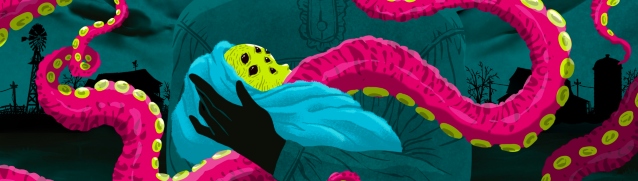
“Help me,” I whisper to my sister, as we carefully maneuver and tug until my mother is swaddled in the yellow baby blanket, her dollies against her chest, her stomach full. We wrap her tight, hold her and rock her as though she is a long, thin baby. She grows smaller in our arms, and Marieke—voice unexpectedly deep and slow—sings her hymns that sound like the blues.
In the morning, I have a sore throat, a hangover, and a yellow blanket filled with pink plastic babies.
We fly our starling ways, and I promise my sister I’ll do better with keeping in touch. When I land again, after hours of cramped seats and gritty layovers, through Edinburgh customs, I step out under grey bleak skies, the air cold and bitter.
I empty the rubbish from my coat pockets into the bin—tickets and bits of mint wrappers, and a crushed, misshapen baby doll, pink as a tumor—and wait for the bus.
 |
CL Hellisen lives somewhere between Scotland and the Hypnagog. Originally from Cape Town, South Africa, their stories are influenced by the borders between waking and dreaming, urban and rural, myth and superstition, land and water. Their shorts and poems have appeared in The Magazine of Science Fiction and Fantasy, Apex, Shimmer, Strange Horizons, Shoreline of Infinity, and others, and their work has been shortlisted for multiple awards. Their latest novel The Shape of Monsters is a dark, gothic fantasy where two siblings are slowly corrupted by the magic they think will save them. When not writing, CL Hellisen throws themself repeatedly at a large block of ice for fun as a figure skater and ice dancer. They like exploring rivers in cities, and finding pubs with crows carved into the beams and pictures of saints who don’t exist on the walls. | |
Mooi! Dark, deep, but mooi. We don’t have enough SFF writers in S Africa.